
The story of a First World War Soldier…
Complied by Sherree Haring from various family sources and from information found on relevant websites.
The story of No 2394, Private William Crossman of the 7th Reinforcements 5th Australian Division’s, 5th Infantry Brigade’s, 59th Battalion, Australian Infantry Forces.

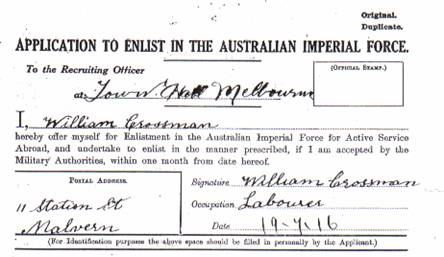
Our Great Great Uncle Willy/William/Bill Crossman born 1884 was a 33 year old bachelor native of Milloo, Victoria, when he made an application to join the Australian Imperial Force on the 19th of July 1916. Fourteen months later he was killed in action at dusk on 26th September, 1917 the first day of the AIF’s second step which was to take Polygon Woods from German occupation. Willy was fatally wounded just as the AIF had secured their objective.
His father William Senior and his mother Mary Hannah Royle/Crossman were 60 years old when Willy, their firstborn son applied to join up. His siblings were Ruth (Nannie) Stewart aged 35, Amy (Mrs Ferris) aged 31, Elizabeth (Mrs J. Roberts see attached letters) aged 29 and his younger brother Samuel 27 who has enlisted a year prior to Willy and is already in Europe, Sam returns home to his wife in 1919 after 4 years away fighting.


Willy traveled on the Shropshire, a troop carrier in 1916.


Barnes, J. E. photographer.
Troops aboard the “Shropshire” Nov. 22 1916 [picture]
Date(s) of creation: [Nov. 22, 1916]
photograph : gelatin silver ; 23.7 x 30.8 cm., on mount.
Reproduction rights owned by the State Library of Victoria
Accession Number: H15437
Image Number: b28472 © 2004 State Library of Victoria

Barnes, J. E. photographer.
Shropshire picture
Date(s) of creation: May 11, 1917.
photograph : gelatin silver ; 11.2 x 15.8 cm.
Reproduction rights owned by the State Library of Victoria
Accession Number: H21104
Image Number: a17527 © 2004 State Library of Victoria
Uncle Willy’s colour strip in the 59th Battalion


The family knew that Willy had been killed. Both his father William and his sister Elizabeth write letters in an effort to find out more information and when they will get his personal belongings, below:

The list of his personal effects that the family so anxiously awaited.

Letter written by Nannie’s sister Elizabeth seeking information about their brother Willy:

Letter written by Willy’s father William informing the Argus that he had read the notice in the paper about his son

Unfortunately his personal effects were lost at sea on the Barung as advise in the correspondence below:

A photo of the Barunga as it sinks after being torpedoed taking Willy’s personal effects down to the bottom of the Atlantic.

Tale of disappointment when the personal effects were lost:
Willy’s wallet, bible and name tags were lost on the ship the Barunga when it was en route to Australia in July 1918. It was torpedoed by enemy U Boats. It lies with many other ships that met the same fate in WW1.
Barunga, 7,484grt, defensively-armed, 15 July 1918, 150 miles W by S ½ S from Bishop Rock, torpedoed without warning and sunk. Unfortunately Willy’s personal effects, and those of many other fallen soldier, never reached their families in Australia. The “Barunga” was sunk on its way to Australia by enemy action and all its cargo was lost.

The Barunga was torpedoed just a days travel out of Plymouth, south west of Bishop Rock lighthouse near the Scilly Isles located at England’s toe.


A famous ship rests near the Barunga
A sad fate would end Carpathia’s career after gaining fame as the “rescue ship” to Titanic’s survivors. On July 17, 1918, she was traveling in convoy to Boston. Spotted by a German U-Boat, Carpathia was suddenly struck by two torpedoes 170 miles from Bishop’s rock off of the Isles of Scilly. As the crew were manning the lifeboats, the ship was struck by a third torpedo. Five crew members were killed instantly. The remainder of the crew and Carpathia’s 57 passengers were picked up by the HMS Snowdrop and returned to Liverpool. The Carpathia sank at 12:40 AM on that morning

His father William Crossman Senior received the following in honour of his son’s personal sacrifice for his country:-


| Name: | CROSSMAN, WILLIAM REEVES |
| Initials: | W R |
| Nationality: | Australian |
| Rank: | Private |
| Regiment: | Australian Infantry, A.I.F |
| Unit Text: | 59th Bn. |
| Age: | 34 |
| Date of Death: | 26/09/1917 |
| Service No: | 2394 |
| Additional information: | Son of William & Mary Hannah Crossman. Native of Milloo, Victoria. |
| Casualty Type: | Commonwealth War Dead |
| Grave/Memorial Reference: | Panel 7 – 17 – 23 – 25 – 27 – 29 – 31 |
| Cemetery: | YPRES (MENIN GATE) MEMORIAL |


The 59th spent the winter of 1916–17 rotating in and out of the front line. In March 1917 the battalion participated in the advance that followed the German retreat to the Hindenburg Line, but was spared having to assault it. It did, however, defend gains made during the second battle of Bullecourt. Later in the year, the AIF’s focus of operations switched to the Ypres sector in Belgium.
The 59th’s major battle there was at Polygon Wood on 26 September.
And the 26th September 1917 is the date Willy was Killed in Action

Polygon Wood, near Ypres in Belgium, was captured by the Australian 5th Division on September 26, 1917 during the Battle of Menin Road. The wood had changed hands several times during the early stages of the war and had been devastated by shell fire. The term “wood” is misleading as, by the time the Australians arrived in the sector in 1917, shelling had reduced it to a forest of shattered tree stumps and saplings “no more than waist high”, according to one soldier.

Polygon Wood’s most prominent feature was the “Buttes”, a large earth mound which had been the backdrop of the Ypres rifle range before the war. With the wood devoid of trees, the Buttes became a prominent landmark and offered the German defenders commanding views over the surrounding countryside. The Germans fortified the Buttes with machine guns and barbed wire, and constructed dugouts and tunnels within it. Pre-war Polygon Wood also contained a race track, clearly marked on contemporary trench maps but indistinguishable by 1917.
The Germans incorporated Polygon Wood into their “Wilhelm Line” defence system and constructed several concrete pillboxes in the wood and surrounding area.

The attack on Polygon Wood was the 5th Division’s first major battle since it was savaged at the disastrous attack at Fromelles in July 1916 (although parts of the Division had been present at Bullecourt in April 1917). It would attack with the Australian 4th Division on its left and five British Divisions also taking part.
- Black Watch Corner marks the sight of a notorious incident in AIF history. During the attack on Polygon Wood, a pillbox located near here held up the advance. It was eventually overcome and its occupiers surrendered. Captain F. Moore rushed forward to accept the surrender of the pillbox. According to witnesses, a German soldier who had already surrendered saw Moore approaching, picked up his weapon, killed Moore and then surrendered again. The Australians were outraged at this act of treachery and killed the German. They would have wiped out the entire garrison if a group of officers had not intervened.
The troops advanced in the early hours of September 26, close behind a creeping artillery barrage. The barrage was, in the words of C. E. W. Bean, Australia’s Official War Historian, “the most perfect that ever protected Australian troops”. Under the protection of this barrage, the Australians advanced in several stages. The concrete pillboxes were manned by German machine gun teams who resisted fiercely and almost all had to be captured by acts of individual bravery.
The Australians captured the pillboxes in what later became the classic style: a Lewis gun would fire on the pillbox, supported by fire from rifle grenades, while an assault team would manoeuvre around to the back of the pillbox, rather than attacking it head on. The technique worked effectively in most cases, but attacking pillboxes was never an easy task and casualties were seldom small.

Private Patrick Bugden, of the 31st Battalion, led small parties in the capture of two pillboxes and later rescued a captured Australian corporal who was being led to the rear by three Germans.
On at least five other occasions Bugden rescued wounded men under heavy fire. He was killed on September 28.
For his bravery and devotion to duty he was awarded the Victoria Cross.

Private Bugden was buried by his comrades in nearby Glencourse Wood, with an elaborate cross and a low fence around his grave. He now lies in Hooge Crater Cemetery.
By nightfall on September 26 the 5th Division occupied the wood. The final objective, beyond the wood, was secured by the afternoon of the 27th.


The 3rd Battle of Ypres (also known as Passchendaele after its climactic Battle) was the major British offensive in Flanders in 1917. It consisted of eleven separate deliberate attacks, in corps to army group strength. Anzac troops participated in seven of these attacks. The Battle started with the same old attrition method used on the Somme (including Pozieres) in 1916, developed into the “step my step” approach, which in fine conditions resulted in the three brilliantly successful Battles of Menin Road, Polygon Wood, and Broodseinde, followed by reversion to heavy losses for minimal gains in the mud at Passchendaele.
The “step by step” approach was a tactical innovation. Its key elements were a heavy preliminary bombardment, followed by a swift infantry advance to escape the German counter bombardment. The infantry attacked under the protection of its own creeping barrage. There was a very dense concentration of force on narrow frontages (about 1,000 m per division) against limited objectives, followed by long pauses (about 1 hr) to enable reorganisation and the continuation of the attack. The Battle was planned as a succession of limited offensives, to follow one another at a few days interval, pausing to push forward the artillery, and to relieve the tired infantry with fresh troops.
The Battle of Menin Road opened on 20 Sep, and met with almost complete success. 1st Div (including 1st Bn) and 2nd Div (including 19th Bn) formed the centre of the attacking force. Never before had two Australian divisions attacked side by side, and the Diggers were consequently elated with a confidence and enthusiasm which British leaders did not, at that time, understand.
The Battle of Polygon Wood opened on 26 Sep, under the most perfect barrage that had ever protected Australian troops. All objectives were quickly captured by the fresh 4th and 5th Divs.
For Australia, as for many nations, the First World War remains the most costly conflict ever in terms of deaths and casualties. From a population of fewer than five million, 300,000 men enlisted, of which over 60,000 were killed and 156,000 were wounded, gassed or taken prisoner.


Witnesses Statements:


Polygon Wood Memorial


Memorial at Polygon Wood
Belgium


The Menin Gate as it was before WW1.

.
The Menin Gate consisted of two lions, one each side of the main Road through Ypres (Iepers) Belgium. This is the road that the soldiers took to the Western Front. If you look closely, you will see the two limestone lions on their brick pedestals.
These are the Lions that Uncle Willy marched between on his way to the Battle at Polygon Woods, where he was Killed in Action at dusk on the 26th September, 1917.
Menin Gate immediately after World War 1.

Menin gate after WW1, the Lions and everything else are gone?

The Original Menin Gate Lions were retrieved, repaired and given to the Australian War Memorial in Canberra.

The WW1 Memorial, the new Menin Gate, Ypres, Belgium opened in 1927, where Buglers play the Last Post every evening at 8pm in honour of the men who saved their town and who have no known grave. There is a Lion atop the Gate.

Willy’s name carved in Portland stone on Menin Gate:


“We can truly say that the whole circuit of the earth is girdled with the graves of our dead… and, in the course of my pilgrimage, I have many times asked myself whether there can be more potent advocates of peace upon earth through the years to come, than this massed multitude of silent witnesses to the desolation of war.”
King George V, Flanders, 1922


-
Mitiamo to Polygon Wood.
A long way from home… From an Australian population of fewer than five million, over four hundred thousand (416,809) Australians voluntarily enlisted for service in the First World War, representing 38.7% of the male population aged 18 to 44. Of this number 315,000 served overseas. Overall Australia transported over 400,000 troops and over 139,000 horses.… Read more
-
Letters Home from World War 1.
By Doug Stewart 10th October 2010 Letters from Billy (Uncle Willy) and his brother Thomas Samuel (Sam Crossman) sent to their home in Australia. Lizzie, Amy and Ruth (Nannie) are their sisters. Olive is Sam’s future wife and Ted Crossman’s parents. George Mueller may have been a good friend of Sam’s. Letters from Sam From… Read more
Follow My Blog
Get new content delivered directly to your inbox.
 Private Willy Crossman AIF